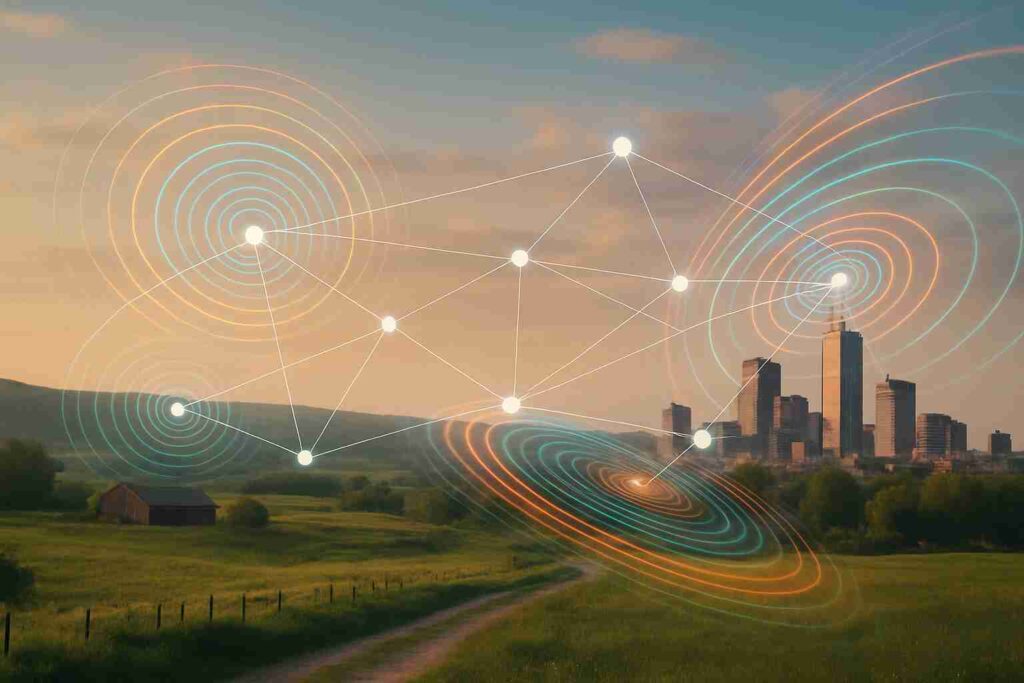

In a time when connection matters most, communicating without relying on conventional infrastructure is becoming an essential benefit. Utilizing technologies such as LoRa, off-grid mesh networking opens up extraordinary possibilities for autonomous communication networks and urgent communication services. This piece explores the complexities of these platforms, their technological foundation, and their essential function in preserving confidentiality in mesh networks while ensuring continuous connectivity.
The Basics of Mesh and Off-Grid Networking
Off-grid mesh networking offers a vital communication lifeline beyond the scope of conventional internet access. This system operates on a peer-based communication network where each node—whether a smartphone or a dedicated router—directly exchanges information with others. Acting as both sender and receiver, every node forwards messages across the network until they reach their intended endpoint. Importantly, this eliminates reliance on central infrastructure or routers, proving essential in locations lacking cellular or broadband coverage.
Particularly valuable for connecting isolated regions, this technology enables communities to maintain contact and utilize critical services. Its role during natural catastrophes is especially notable; when standard networks collapse, off-grid mesh networking ensures communication remains possible between emergency responders and those impacted. Setting up these networks is typically straightforward, often using affordable, simple-to-deploy technology like LoRa (Long Range), which supports connectivity spanning many miles without needing power-heavy infrastructure. This combination of ease and durability makes mesh networks a smart choice for boosting connectivity in difficult environments.
Understanding Decentralized Communication Systems
Distributed communication systems mark an intriguing evolution away from traditional centralized networks, offering a variety of benefits. Unlike centralized networks that depend heavily on a single central hub—making them susceptible to failures or targeted attacks—these systems spread control among multiple nodes, removing the risk of a sole point of failure. This design significantly boosts the robustness and protection of communication, an aspect that becomes vital during crises or natural calamities.
In such urgent situations, decentralized messaging frameworks prove exceptional by guaranteeing that if one node becomes inoperative, others continue to support communication, preserving the network’s functionality. This peer-to-peer communication model enhances confidentiality, as every node independently transmits and receives information, thus lowering the chance of widespread surveillance typical in centralized architectures.
Technologies like BitTorrent and blockchain-based communication solutions demonstrate the practical success of these systems across diverse sectors. Yet, challenges persist, especially in managing synchronization and keeping communication efficient as nodes frequently join or exit.
More than just promising enhanced security and durability, decentralization forms the backbone of off-grid mesh networking, enabling connections in isolated regions and sustaining communication when conventional infrastructures fail.
LoRa Technology: The Backbone of Long-Range Connectivity
LoRa technology—abbreviated from Long Range—has revolutionized modern communication infrastructures, especially in distant and isolated regions. Developed as part of wireless communication innovations, LoRa is celebrated for its capacity to transmit data over several kilometers while maintaining very low energy use. This makes it an essential choice for setups where frequent battery replacement is impractical. Within the realm of off-grid mesh networking, its potential surpasses traditional networking approaches.
In the Internet of Things (IoT) domain, LoRa uniquely enables smooth connectivity for applications such as precision farming and supply chain logistics. Through LoRa, farmers can track crop conditions, soil moisture, and animals, while logistics operators monitor shipments across expansive distances thanks to its impressive range. The LoRaWAN protocol, which runs over LoRa technology, guarantees safe data exchange and supports an extensive number of connected devices—an indispensable factor for IoT deployment.
When it comes to off-grid mesh networking and crisis communication, LoRa becomes a vital tool. Its reliable long-distance message delivery ensures that critical information reaches emergency teams quickly, facilitating effective coordination during urgent situations. This capability underscores LoRa’s fundamental role in distributed communication systems, laying the groundwork for future technological progress.
Emergency Communication: Ensuring Reliability When It Matters Most
During emergencies, having a dependable communication platform is vital. Emergency notification systems have progressed over time, with a focus on addressing urgent connectivity needs when conventional infrastructures collapse. Introducing off-grid mesh networking powered by LoRa technology, a revolutionary advancement for emergency responders and affected communities. These platforms offer a robust framework featuring swift deployment, scalability, and bidirectional communication, essential in situations such as hurricanes or earthquakes.
One key advantage of off-grid mesh networking is its operation independent of standard infrastructure, utilizing interconnected nodes that easily expand to meet demand. This quality makes them particularly useful in isolated or disaster-impacted regions where traditional communication channels are disrupted. For instance, following Hurricane Maria, distributed communication systems facilitated contact among remote Puerto Rican communities, illustrating practical application and areas for further enhancement.
Nonetheless, these platforms encounter obstacles such as signal interference and limited range, which may restrict coverage. Ongoing innovations strive to improve these features, aiming to make networks even more resilient and vital for emergency readiness.
Building and Maintaining a Private Mesh Network
Creating a reliable private mesh network demands meticulous planning and attention to detail. Start by acquiring the right hardware, focusing mainly on LoRa-enabled devices, which play a vital role in ensuring dependable long-distance communication. To guarantee smooth integration across your network, choose devices that work effortlessly with popular components such as Raspberry Pi or Arduino, promoting both adaptability and affordability.
Strategically placing your nodes to enhance signal quality and reduce interference should be a top priority during network setup. Employ strong encryption practices and firewall protections to defend your data and uphold user confidentiality, thus preventing unauthorized intrusions. Efficient management of the network and routing can be achieved through community-driven open-source wireless mesh solutions, streamlining your entire configuration.
Consistent upkeep is key to sustaining optimal network performance. Frequently update device firmware and keep an eye on network activity to quickly identify and fix any slowdowns. Always stay informed about legal obligations, especially those concerning radio spectrum use and data privacy, to maintain compliance. Understanding the regulatory environment specific to your location is crucial, as violations could lead to penalties. By carefully addressing these facets, your off-grid mesh networking setup can deliver a robust, private communication platform built to endure.
Conclusions
Off-grid mesh networking, supported by LoRa technology, transforms our approach to communication by enabling secure, decentralized, and resilient networks. From enhancing emergency response capabilities to empowering remote communities with connectivity, these networks offer promising solutions for modern and future challenges. Understanding and adopting these technologies will pave the way for a more connected and adaptive world.
Supported by LoRa mesh networking, off-grid connectivity reshapes how we communicate by fostering protected mesh network architecture that is both autonomous and resilient. These networks provide promising answers to contemporary and forthcoming challenges, from strengthening crisis communication systems to delivering network access for isolated regions. Embracing and comprehending these LoRa network applications will open the door to a more adaptive and interconnected future.