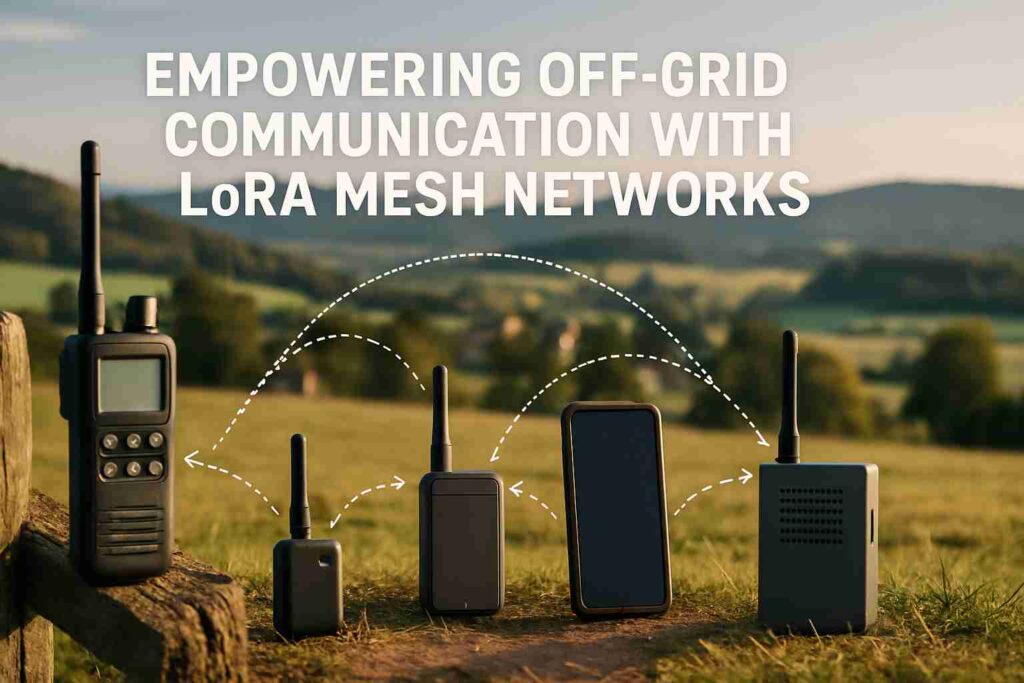

Communication that extends beyond traditional infrastructure is crucial in today’s era. Offering a revolutionary approach to autonomous wireless connectivity, LoRa mesh networking enables distributed communication systems with extensive range, energy-efficient devices, and strong protection. This article explores how LoRa mesh networks are transforming connectivity, particularly in remote or difficult-to-access settings.
Exploring LoRa Technology and Its Applications
LoRa technology has transformed communication frameworks, especially in industries demanding durable, energy-saving options. At its foundation, LoRa employs a proprietary modulation method, enabling long-range data transmission while minimizing power use. This unique blend of characteristics makes it highly effective for deploying Internet of Things wide area communication, facilitating effortless remote monitoring and control. LoRa’s capability to penetrate physical obstacles boosts its performance in both countryside and metropolitan environments, overcoming conventional communication limits.
Such versatility establishes LoRa as a crucial element in numerous fields, ranging from precision farming technology to next-generation smart city technologies. Its proficiency in functioning efficiently amidst obstructions such as dense vegetation or urban structures highlights its applicability across varied terrains. In agritech innovations, LoRa connects farmers with important information about soil conditions or animal health, providing timely data with low energy consumption. Within city landscapes, it underpins smart metropolitan infrastructure solutions, enabling seamless optimization of traffic, resource allocation, and environmental monitoring. Moreover, LoRa serves as the foundation for LoRa mesh network architectures, boosting connectivity without dependence on centralized setups, thereby assuring stable communication despite local infrastructure limitations.
Understanding Mesh Networks and LoRa’s Role
In a LoRa mesh network, robust connections thrive on simplicity and efficiency to bridge difficult terrains. Acting as relays, every device within this network ensures that data arrives at its endpoint even if one node fails. Thanks to LoRa’s impressive long-range low-power network capabilities, it can cover extensive regions, delivering connectivity where traditional infrastructure falls short. These devices’ minimal energy consumption is a significant advantage, minimizing the frequency of battery changes and supporting network endurance in isolated region connectivity scenarios. This adaptive mesh arrangement proves essential in locations without existing infrastructure, where dependable communication plays a crucial role in daily operations and critical emergency situations.
The network’s self-repairing telecommunication systems are crucial, as they autonomously identify alternate paths when nodes go offline, preserving uninterrupted communication with no human input. This flexibility is especially valuable during natural disasters, enabling the network to restructure itself independently and guarantee that important messages get through. Coupled with LoRa’s scalability, this resilience facilitates fluid growth, accommodating additional deployments or traffic surges without bottlenecks. Practically, these traits make a LoRa mesh network an indispensable resource for ensuring reliable connectivity everywhere.
Benefits of Decentralized Mesh Architecture
Decentralized mesh architecture within LoRa mesh networks presents distinct benefits by eliminating single points of failure. Each node functions autonomously in this model, enabling increased robustness against both unexpected outages and deliberate attacks. Such resilience is vital, especially in off-grid communication solutions where sustaining connectivity amid disasters or technical interruptions is critical. Additionally, distributed control enhances privacy protection, as information does not pass through centralized servers, thus minimizing vulnerability to breaches. By distributing governance, a wider array of users and entities can easily join the network, promoting democratized access to dependable connectivity. This open accessibility encourages innovation and guarantees a flexible, adaptive network capable of swiftly adjusting to evolving user demands or environmental shifts. Shared responsibility also simplifies network upkeep and troubleshooting, improving long-term sustainability. For mission-critical communication systems where stability is paramount, this framework offers unparalleled dependability. Leveraging a decentralized system, LoRa mesh networks support a wide range of uses—from rural network access to emergency response communication systems—ensuring connectivity when it is needed most.
Leveraging Low-Power Devices in LoRa Mesh Networks
Integrating energy-efficient IoT devices into a LoRa mesh network demands careful attention to efficiency and resource optimization. Thanks to LoRa battery longevity optimization, these gadgets are perfect for autonomous wireless connectivity and remote location networking. Their low power requirement significantly cuts down maintenance intervals and costs by prolonging battery replacement cycles. This feature is especially valuable in Internet of Things wide area communication scenarios where physical access is limited. Lowering energy use helps organizations reduce expenses while boosting the network’s operational lifespan.
Such efficiency not only promotes sustainability but also enables wider deployments without the hefty resource demands typical of alternative technologies. Additionally, it complements the growing emphasis on environmentally sustainable network technologies in modern implementations. When uninterrupted service is critical, energy-saving mesh systems become indispensable for reliable and resilient performance.
Ultimately, employing power-efficient IoT devices within a LoRa mesh network equips operators with a technology that balances economic viability and ecological responsibility, a vital consideration as scalable networks continue to develop.
Enhancing Security in Mesh Networks
Security plays a vital role in any communication network, and LoRa mesh network is no exception. To protect data and maintain user privacy, these systems use advanced mesh network cryptographic methods. As cyber threats evolve, implementing sophisticated encryption techniques becomes crucial to defend communications against unauthorized intrusion. By encrypting information at each relay point within the mesh, confidentiality is preserved, ensuring that intercepted data stays incomprehensible to outsiders. This is especially critical in distributed communication systems, as data travels across numerous nodes—each potentially vulnerable. The protected design of a LoRa mesh network builds confidence among users relying on dependable messaging platforms in demanding scenarios. Moreover, by continuously refining and updating resilient communication protocols, these networks stay prepared against emerging risks and maintain a robust defense against breaches. Strong security verification mechanisms additionally block unauthorized devices from accessing the network. Together, these encryption and authentication protocols uphold the integrity and dependability of LoRa mesh communication, positioning it as essential infrastructure equipped to face today’s intensifying cybersecurity challenges.
Conclusions
By providing distributed communication systems that are energy-efficient and secure for extended-distance communication, LoRa mesh networks are transforming how connectivity is achieved. Perfect for standalone wireless communication scenarios, these networks support reliable and sustainable communication frameworks in a variety of settings. Embracing LoRaWAN mesh networking allows for enhanced flexibility, improved efficiency, and robust protection, shaping a connected future that surpasses conventional network limits.